Did you know that heating and cooling can account for up to 50% of the energy used in a building? It's a staggering figure. Many Salt Lake Valley homeowners are paying premium prices for comfort they aren't even home to enjoy. Most people assume that simply mounting a new device on the wall is enough. However, a truly efficient programmable thermostat setup requires more than just two screws and a prayer. If you've been staring at a nest of colored wires or worrying about a missing C-wire connection, you aren't alone.
We understand the frustration of seeing high utility bills even after upgrading your hardware. It's stressful to worry about blowing a fuse on your furnace control board because a wiring diagram is confusing. You deserve a home that stays comfortable without constant manual adjustments. This guide will teach you how to correctly install, wire, and program your unit to handle Utah's unique climate. We'll walk through the technical details and show you how to maximize your energy savings, ensuring your system works perfectly from the moment you flip the power back on.
Key Takeaways
- Save up to 10% on annual energy costs by automating temperature changes to match your daily routine in the Salt Lake Valley.
- Ensure a safe installation by following critical steps for powering down your HVAC system and labeling wire terminals correctly.
- Optimize your programmable thermostat setup with specific winter setpoints designed to handle Utah's freezing nights and active mornings.
- Quickly troubleshoot common errors like blank screens or system delays to restore comfort without the stress of technical guesswork.
- Identify when complex multi-stage or dual-fuel systems require professional calibration to protect your equipment warranty and efficiency.
Why Proper Programmable Thermostat Setup Matters in Utah
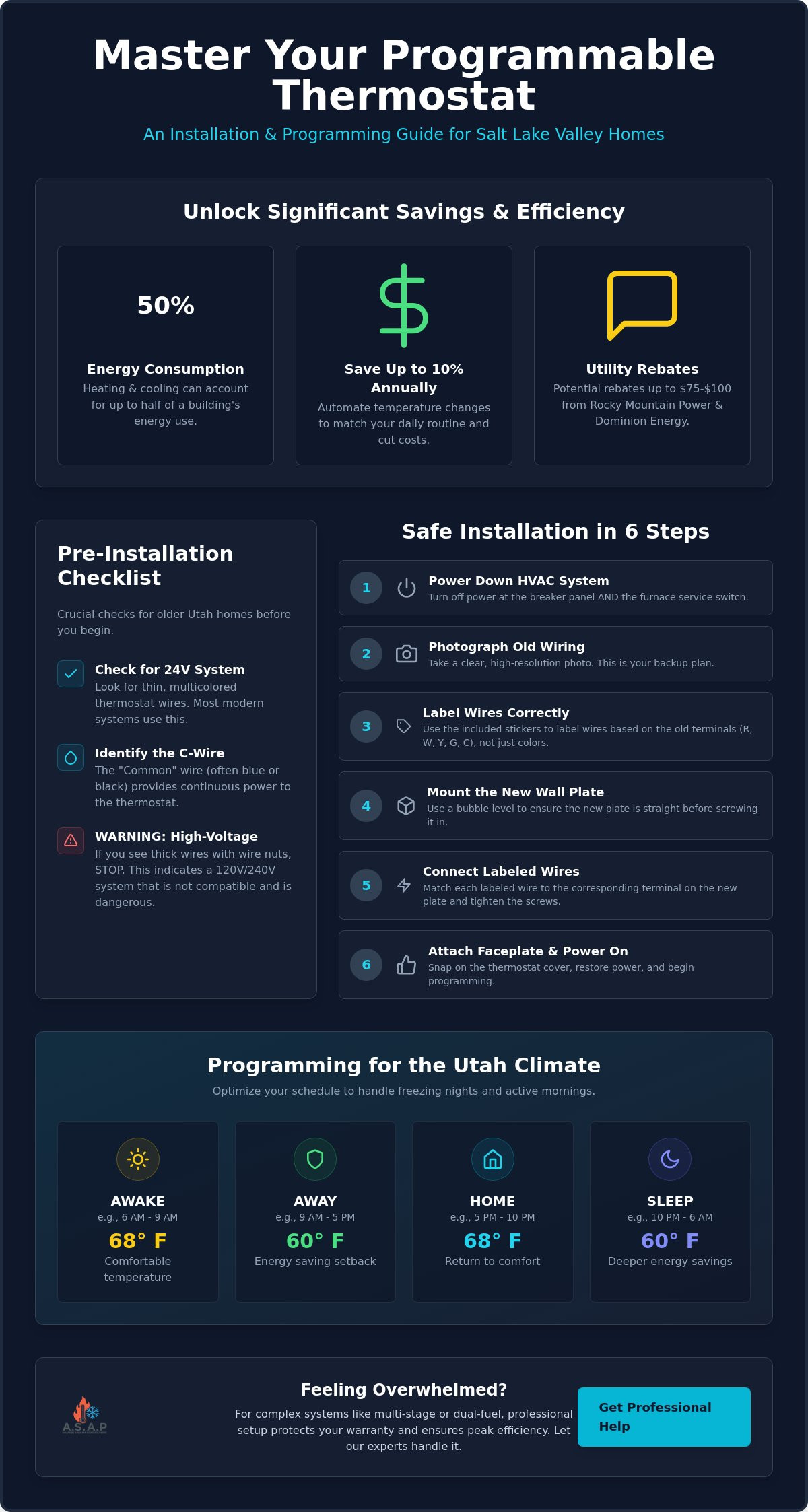
Before you dive into the wiring, you need to understand the tool you're holding. What is a Programmable Thermostat? Simply put, it's a device that automates temperature changes based on your daily schedule. For Salt Lake Valley residents, this isn't just about convenience. A correctly configured programmable thermostat setup can save you up to 10% on your annual heating and cooling costs. In a climate where we swing from blistering summer afternoons to freezing winter nights, that's a significant return on a small investment.
Precision matters for more than just your wallet. It's about protecting your HVAC equipment. When a thermostat isn't set up correctly, your furnace or AC might experience "short-cycling." This happens when the system turns on and off too frequently. It puts massive strain on the motor and electrical components, which often leads to premature failure. We want your system to run in steady, efficient cycles that maintain comfort without burning out the hardware.
You should also look into local incentives before you finish your installation. Utility providers like Rocky Mountain Power and Dominion Energy often encourage energy efficiency through rebate programs. For example, you might be eligible for a $75 rebate from Rocky Mountain Power or up to $100 from Dominion Energy for installing an approved unit. These programs align perfectly with a professional programmable thermostat setup, making the upgrade even more affordable for local families.
The Impact on Your Salt Lake Utility Bills
Utah winters don't play fair. On those peak nights when the temperature drops below freezing, your furnace works overtime. Automated setbacks allow the temperature to dip while you're asleep or at work, reducing the heavy load on your system. This precision is vital for older homes in the valley where gas consumption can skyrocket if the thermostat isn't calibrated perfectly. Don't fall for the "set it and forget it" myth. Maximum efficiency requires a schedule that adapts to our local seasonal shifts.
Compatibility Check for Older Utah Homes
If you live in a classic Sandy or Cottonwood Heights residence, your wiring might be decades old. Most modern thermostats require a 24V system, which is common in these areas. However, you must be careful. If your home uses high-voltage baseboard heaters, a standard programmable unit won't work and could be dangerous. You also need to verify the presence of a "C-wire" or Common wire. This wire provides continuous power to the thermostat. Without it, your new unit might lose its programming or fail to trigger the furnace when you need it most.
- Check for 24V compatibility: Look for thin, multicolored wires.
- Identify the C-wire: Usually blue or black, this wire is the "power" source for the display.
- Avoid high-voltage: Thick wires with wire nuts usually indicate a 120V or 240V system.
Step-by-Step Physical Installation and Wiring Guide
Safety isn't optional when you're working with your home's electrical system. Before you touch a single wire, head to your breaker panel and shut off the power to your HVAC system. You should also flip the service switch located on the side of your furnace. This double-layer of protection prevents you from accidentally blowing a fuse on the control board, which is a common and costly mistake during a DIY programmable thermostat setup. Once the power is dead, pop the old cover off and take a high-resolution photo of the existing wiring. This photo is your ultimate backup plan.
Don't trust wire colors alone. In many older Salt Lake City homes, a red wire might not actually be the "R" connection. Use the stickers included with your new unit to mark R, W, Y, G, and C based on the terminals they were attached to on the old baseplate. This ensures that your furnace, air conditioner, and fan all receive the correct signals. After labeling, unscrew the wires and remove the old wall plate. When mounting the new plate, use a bubble level. While modern digital units don't use mercury switches that require perfect leveling to function, a tilted thermostat looks unprofessional and can cause internal strain on the terminal blocks.
Connecting the new unit is a matter of matching your labeled wires to the corresponding letters on the new terminal block. Insert each wire firmly and tighten the set screws. If you feel overwhelmed by the nest of wires behind your wall, our team offers professional thermostat installation to give you total peace of mind and ensure your system is calibrated for the local climate.
The C-Wire Solution for Smart Features
Many Salt Lake Valley homes built before the 1990s lack the blue "C-wire" or Common wire. This wire is essential because it provides a continuous loop of 24V power. Smart units need this constant energy to maintain Wi-Fi connectivity and power their backlit displays. If you're missing this wire, you have two main choices. You can use a Power Extender Kit (PEK), which often comes with high-end models, or you can pull a new 18/5 thermostat wire from the furnace to the wall. Having a dedicated power source is one way to ensure your unit helps you save as much as 10% a year on your utility bills by preventing frequent resets.
Wiring Differences: Furnace vs. Heat Pump
Configuring a heat pump requires a different approach than a standard gas furnace. You must identify the "O/B" terminal, which controls the reversing valve that switches your system between heating and cooling modes. During Utah's freezing winters, your heat pump may need help from "auxiliary" or emergency heat. This is usually connected to the "W" or "W2" terminal. If you don't configure this correctly, your home might stay chilly even when the thermostat says it's heating. Always check your thermostat's internal settings to tell it whether it should control the fan directly or let the furnace handle the blower timing.
Programming Your Schedule for the Utah Climate
Choosing the right programming logic is the final hurdle of your programmable thermostat setup. If your work schedule is consistent, a 5-2 model allows you to set one routine for weekdays and another for the weekend. For those with unpredictable hours in Salt Lake, a 7-day model offers the most flexibility. The goal is to align your HVAC usage with your actual presence in the home. You don't want to pay to heat an empty house while you're commuting on I-15.
In Utah, we face drastic temperature swings that require specific setpoints. For winter, we recommend a daytime setpoint of 68°F when you're active at home. At night, dropping the temperature to 60-62°F is ideal for both deep sleep and maximum savings. During our scorching high-desert summers, aim for a baseline of 78°F when you're away. These numbers align with general Department of Energy energy-saving tips, but they're specifically tuned for the dry air and elevation of the Wasatch Front.
You also need to account for your system's recovery time. Your furnace doesn't reach 68°F instantly. Depending on your home's insulation and the age of your unit, it might take 30 to 60 minutes to climb six degrees. Learn your system's rhythm so you aren't shivering while waiting for the heat to catch up. A successful programmable thermostat setup means the house is already comfortable the moment you walk through the door.
Winter Strategy for Salt Lake County Homes
Extreme setbacks are a trap. If you let your home drop below 55°F, your furnace has to work at maximum capacity for hours to "recover" that heat. This often costs more than if you had maintained a slightly higher baseline. Keeping a steady minimum heat also protects pipes in uninsulated crawlspaces from freezing during a sudden canyon wind event. Use "Early Start" features to begin the warming process at 6:00 AM so the kitchen is warm by 7:00 AM.
Maximizing Efficiency with Zoned Systems
Many homes in Draper or Park City feature multiple stories that require coordinated scheduling. Set the upstairs unit a few degrees higher in winter, as heat naturally rises from the lower levels. In large basements, remote sensors are your best friend. They tell the thermostat the actual temperature in that far bedroom, not just the hallway. This balances out cold spots and prevents your upstairs and downstairs units from conflicting with one another.
Troubleshooting Common Setup and Programming Errors
If you finish your programmable thermostat setup and the screen stays blank, don't panic. The most common culprit is actually the furnace door. Most units have a safety switch that cuts all power if the service panel isn't perfectly seated. Check the panel first. If it's secure, re-verify your C-wire connection at both the thermostat and the furnace control board. Without a solid 24V loop, smart displays won't have the energy to turn on. For systems where the air conditioner refuses to kick on, check the "Y" wire. Remember that almost every modern thermostat has a built-in 5-minute delay to protect the equipment. Give it a few minutes before you start pulling wires again.
Furnace short-cycling is another technical headache that often stems from the settings menu rather than the hardware. If your heat turns on and off every few minutes, look for the "Cycle Rate" or "Cycles Per Hour" (CPH) in the advanced installer menu. For standard gas furnaces, a lower CPH prevents the system from wearing itself out with constant restarts. If your Wi-Fi connection keeps dropping, consider the age of your home. Many older residences in the Salt Lake Valley have thick plaster walls or metal lath that blocks signals. You might need to move your router or add a mesh node closer to the thermostat to maintain a stable connection.
Correcting Wiring Mismatches
Swapping the "R" (Power) and "C" (Common) wires is a classic mistake that usually ends with a blown 3-amp fuse on your furnace's control board. If your fan (G-wire) runs constantly even when the heat or AC is off, you likely have a misconfigured fan control setting or a stray wire strand touching another terminal. When a programmable thermostat setup goes sideways, the best move is often a factory reset. This clears any accidental programming errors and lets you run the setup wizard from scratch. If your system still won't respond correctly, book a professional diagnostic visit to ensure your wiring hasn't caused a hidden short in your HVAC system.
System Protection Settings
Deep in your settings menu, you'll find "Compressor Protection." Ensure this is enabled. It prevents the air conditioner from restarting immediately after a power flicker, which can destroy the compressor motor. You should also look for "Adaptive Intelligent Recovery." This feature learns the specific heating rhythm of your home, allowing the furnace to start early so you hit your target temperature exactly when your schedule begins. Finally, if you're tired of family members changing the settings, use the keypad lock. It puts an end to "thermostat wars" and protects your energy-saving goals.
When to Call ASAP Heating & Air Duct for Professional Setup
While many homeowners feel confident handling a basic programmable thermostat setup, certain situations demand a professional touch. If your home uses a complex dual-fuel system or a multi-stage furnace, simple wiring isn't enough. These advanced systems require expert calibration to switch between heat sources efficiently. Our technicians understand the nuances of staging and balance points. We ensure your system isn't running the expensive backup heat when the primary unit could handle the load. This level of precision is what separates a standard install from a high-efficiency configuration.
Safety and warranty protection are also major factors. Your HVAC system is one of the most expensive investments in your home. Many manufacturers specify that professional installation is required to keep equipment warranties valid. A DIY mistake that leads to a short circuit could leave you paying for a new control board out of pocket. When you hire a professional, you get a documented record of expert service. This provides peace of mind and keeps your long-term protection plans intact.
Choosing a local expert means getting advice tailored to the Salt Lake Valley. We understand how the canyon winds in Sandy or the unique weather patterns throughout the region affect your home's heating needs. We don't just follow a generic manual. We apply years of local experience to your programmable thermostat setup, ensuring your house stays comfortable through every Utah season. We take the guesswork out of the process so you can focus on your family.
Beyond the Thermostat: Total System Health
A thermostat upgrade is the ideal time for a comprehensive system audit. We take the opportunity to check your airflow and inspect the integrity of your ductwork. It's common for homeowners to blame a "faulty" thermostat for uneven heating when the real issue is a failing blower motor or a leaky duct. We verify that your furnace and air conditioner respond instantly to new commands. This holistic approach ensures that your new technology is actually supported by healthy hardware. We identify small problems before they turn into midnight emergencies.
Schedule Your Professional Install in Salt Lake
We offer fast service for thermostat upgrades in Sandy, Draper, and Murray. Our team provides expert guidance on which models work best with your specific HVAC brand and home layout. Don't settle for a device that's only half-configured. Get your thermostat professionally installed and calibrated by ASAP Heating & Air Duct to start enjoying a more comfortable, efficient home today. We're here to make sure your home stays a sanctuary, no matter what the Utah weather does outside.
Take Control of Your Home Comfort and Energy Bills
Mastery over your home's climate starts with a precise installation and a schedule that actually fits your life. You've learned how to navigate the wiring maze and set setpoints that respect the Wasatch Front's extreme temperature swings. A successful programmable thermostat setup is the bridge between high energy bills and consistent, automated comfort. By ensuring your C-wire is secure and your recovery times are accurate, you're protecting your HVAC hardware from unnecessary wear for years to come.
If you're still feeling unsure about your wiring or want to ensure your system is perfectly calibrated for high-altitude performance, we're here to help. As a locally owned and operated Salt Lake City business, ASAP Heating & Air Duct brings specialized expertise to every neighborhood. Our 5-star rated technicians handle everything from complex multi-stage wiring to full system health audits. We'll make sure your unit is responsive, efficient, and ready for whatever the Utah weather throws your way.
Don't let a confusing diagram stand between you and a more efficient home. Schedule Professional Thermostat Installation in Salt Lake County and start saving today. Your home should be a sanctuary of comfort, and the right setup makes all the difference. We're ready to help you get it right the first time.
Frequently Asked Questions
Do I need a C-wire for a programmable thermostat setup?
It depends on the specific model you choose for your home. Basic digital units often run on simple AA batteries, but modern smart models require a C-wire to provide constant 24V power for Wi-Fi connectivity. If your Salt Lake home lacks this wire, you'll need to install a power adapter or have a professional pull a new 18/5 wire from your furnace.
What are the best energy-saving temperatures for Utah winters?
Aim for 68°F when you're active at home and 60-62°F while you're sleeping or away. This range handles the Wasatch Front's freezing nights without forcing your furnace into an expensive "recovery load" the next morning. Keeping your home at these levels helps balance comfort with the goal of lowering your monthly gas consumption.
Why is my thermostat screen blank after installation?
Check your furnace service door first to ensure it's completely closed and triggering the safety switch. If the door is secure, you may have accidentally blown a 3-amp fuse on the HVAC control board during the programmable thermostat setup. A blank screen usually indicates a total loss of 24V power to the wall unit.
Can I install a smart thermostat on an old furnace in Salt Lake City?
Most older furnaces in the valley are compatible with smart technology as long as they use a standard 24V system. You might need a Power Extender Kit if your old wiring only has two or four strands. However, you should avoid using these units with high-voltage baseboard heaters, as they can cause a fire hazard.
How much can a programmable thermostat actually save me on my Utah heating bill?
Properly configured units save local homeowners approximately 10% on annual heating and cooling costs. These savings come from reducing the load on your system during the day when the house is empty. Over a few years, the device typically pays for itself through lower utility bills and reduced equipment wear.
What is the difference between a 5-2 and a 7-day programmable thermostat?
A 5-2 model allows you to set one schedule for the work week and a different routine for the weekend. A 7-day model is more flexible, letting you program a unique schedule for every single day. Choose the 7-day option if your work hours or Salt Lake commute vary throughout the week.
Will a new thermostat fix my uneven home temperatures?
A thermostat alone won't fix hot or cold spots caused by poor insulation or leaky ductwork. While units with remote sensors can help your furnace "see" a cold basement, they don't change the physical airflow. If your upstairs is always hot and your downstairs is freezing, you likely need a professional ductwork inspection.
How do I know if my thermostat is compatible with my heat pump?
Check the back of your new unit for an "O" or "B" terminal, which is essential for heat pump reversing valves. During your programmable thermostat setup, you must also go into the installer settings to select "Heat Pump" as the system type. If you leave it on "Conventional Gas," your system won't provide heat correctly.