Imagine waking up to a 15-degree Wasatch Front morning only to find your vents blowing ice-cold air. You check your latest utility bill and it’s higher than ever, yet your family is shivering. It’s a stressful situation that no homeowner wants to face. You need a solution, but you likely worry about being pressured into buying equipment you don't need or getting tangled in the complexity of HVAC permits. We know that furnace installation in Utah requires a specific touch because our high-altitude climate and the new July 2026 energy codes demand precision.
It’s completely normal to feel overwhelmed by the technical details of sizing and efficiency. You deserve a warm, safe home and the relief of lower monthly utility bills without the typical industry runaround. This guide will show you exactly how to navigate a furnace replacement with confidence and expert local guidance. We’ll walk you through the latest utility rebates, explain how to pick the right unit for your square footage, and show you how a fast installation process can get your life back to normal immediately.
Key Takeaways
- Understand why Utah’s high altitude requires specialized furnace derating to ensure your system operates safely and efficiently.
- Discover why a 95% AFUE rating is the gold standard for furnace installation utah to maximize your monthly energy savings.
- Master the "50% Rule" to determine if it’s more cost-effective to repair your old unit or invest in a modern replacement.
- Learn the critical warning signs, like a cracked heat exchanger, that indicate your current furnace poses a safety risk to your family.
- Get a clear roadmap of the installation process, from eco-friendly disposal of your old unit to pre-installation home protection.
Why Utah Furnace Installation Requires a Specialized Local Approach
Think of a new heater as more than just a metal box in your basement. Successful furnace installation utah is actually a custom engineering project designed for your specific home layout. Your square footage, the age of your ductwork, and even the direction your windows face change the "math" of your heating needs. A system that's too large will cycle on and off constantly, wearing out parts. A system that's too small will run forever without ever reaching your thermostat's target. We don't just "install" units; we calibrate them to your life.
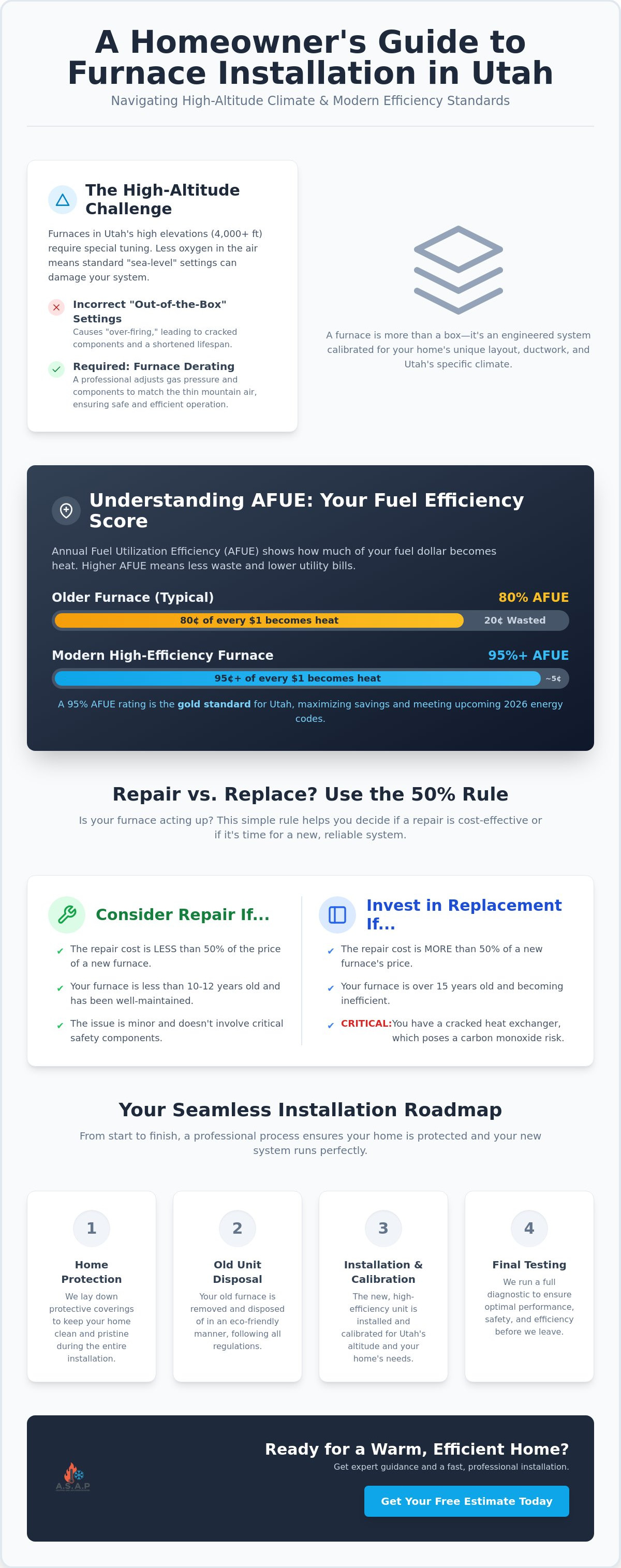
Furnace derating is the adjustment of gas input for high-altitude locations like Salt Lake City. Because there's less oxygen in our mountain air, the chemical reaction of combustion changes. If a technician ignores this, your furnace will "over-fire," creating excessive heat that cracks components. To understand what a high-efficiency condensing gas furnace is and why it requires this specific tuning, you have to look at how these systems extract heat from fuel in thin air. Without local expertise, you're essentially running a sea-level machine in a mountain environment.
The High-Altitude Factor in Salt Lake County
Most furnaces arrive from the factory with "out of the box" settings meant for sea-level cities. In Salt Lake County, these settings usually fail. Our elevations of 4,000 feet and higher require a technician to physically check gas pressure and often swap out the burner orifices. If your installer skips this step, the furnace will struggle to breathe. This leads to "sooting" and premature heat exchanger failure, turning a 20-year investment into a 10-year headache. We ensure your system is tuned for the thin air of the Wasatch Front from day one.
Preparing for the Wasatch Front Winter
Utah weather is famous for its mood swings. Your system needs to handle -10°F January nights and 40°F sunny afternoons in the same week. The extreme temperature inversions common in Salt Lake City trap cold air in the valley, putting immense strain on older units. In neighborhoods like Cottonwood Heights and Sandy, a reliable furnace is the only thing standing between you and frozen, burst pipes during a cold snap. Choosing furnace installation utah through a local expert means your system is sized to survive these brutal temperature drops while keeping your monthly utility bills manageable. We live here too, so we know exactly what your home is up against when the snow starts falling.
Selecting the Right System: Efficiency, Sizing, and AFUE Ratings
Efficiency isn't just a buzzword; it's the difference between a comfortable winter and a financial headache. Choosing the right furnace isn't about picking the biggest unit on the shelf. It’s about matching the system to your home's unique thermal footprint. When we perform a furnace installation utah, we focus on three main pillars: efficiency, proper sizing, and long-term reliability.
AFUE stands for Annual Fuel Utilization Efficiency. Think of this as a grade for your furnace. If a unit has an 80% AFUE rating, 80 cents of every dollar you spend on gas turns into heat, while 20 cents escapes through the chimney. In contrast, a 95% AFUE unit wastes only 5 cents. For most Utah homeowners, a 95% or higher unit is the gold standard. It provides the best balance between upfront cost and monthly savings, especially with our long, freezing winters.
Understanding AFUE Ratings and Your Utility Bills
The jump from an old 80% unit to a modern 96% model can save you hundreds of dollars over a single heating season. According to the U.S. Department of Energy, modern heating system efficiencies have improved so much that upgrading is often the most effective way to lower your carbon footprint. These high-efficiency units are also becoming the baseline for the stricter energy codes taking effect in Utah on July 1, 2026. To get the most out of your investment, we often pair these systems with a smart thermostat. This allows you to manage your home's climate from your phone, ensuring you never pay to heat an empty house.
The Importance of Proper BTU Sizing
The "Goldilocks" rule applies perfectly to heating: you don't want a system that's too big or too small. Many people assume a bigger furnace is better, but an oversized unit will "short-cycle." This means it turns on and off rapidly, which puts massive stress on the heat exchanger and causes uneven temperatures. Conversely, an undersized unit will run non-stop during a record-breaking Salt Lake cold snap, failing to keep you warm while your gas bill skyrockets.
We use a professional "Manual J" load calculation to find your perfect fit. This process considers several factors:
- Total square footage and ceiling height.
- Current insulation levels in your attic and walls.
- The number and type of windows in your home.
- Your home's orientation toward the sun.
If you aren't sure what size your home needs, our team can perform a professional load calculation to give you a definitive answer based on your specific layout.
Repair vs. Replace: When is it Time for a New Furnace?
Deciding whether to fix your heater one more time or finally invest in a new one is a tough choice. We help our customers find clarity by using the "50% Rule." If a single repair quote exceeds 50% of the cost of a new system, it's usually time to stop patching the old unit. While a quick fix might seem cheaper today, you're often just pouring money into a failing machine. Frequent repairs and rising energy bills are the two most common indicators of system failure.
Age is the next major factor to consider. Most furnaces in our region have a typical lifespan of 15 to 20 years. If your unit is approaching two decades of service, its internal components are likely brittle and inefficient. More importantly, safety becomes a concern as a system ages. A cracked heat exchanger is a non-negotiable safety risk that mandates immediate replacement. Because this component separates combustion gases from the air you breathe, any damage can lead to carbon monoxide leaks in your home.
Warning Signs You Can See and Hear
Your furnace often gives you hints before it completely quits. Strange noises are the most common red flag. Banging or rattling usually points to loose parts or a failing motor, while whistling can indicate airflow restrictions. You should also check the color of your burner flame. A healthy flame is always steady and blue. If you see a yellow or flickering flame, it’s a sign of incomplete combustion and potential gas issues. Finally, pay attention to inconsistent heat. If some rooms stay freezing while others are sweltering, your system is struggling to distribute air effectively.
The Hidden Costs of Keeping an Old Unit
Keeping an old unit often creates a "repair treadmill." You might pay for a blower motor this year and an ignitor the next. Over a three-year period, these small bills often add up to a significant portion of a new furnace installation utah. Beyond the direct costs, old units impact your daily comfort. They often fail to manage humidity during our notoriously dry Utah winters, leading to itchy skin and static electricity. A modern system installation provides immediate peace of mind because it’s backed by a manufacturer warranty. You get to enjoy a warm home without the constant anxiety of a "no-heat" emergency in the middle of the night.
What to Expect During Your Furnace Installation Process
Most homeowners feel a bit of anxiety when a crew arrives to tear out a major appliance. We understand that your home is your sanctuary. That's why we treat every furnace installation utah as a precision operation rather than just a construction job. Our goal is to minimize disruption while ensuring every connection is technically perfect. When our team arrives, we follow a disciplined process designed to get your heat back on as quickly as possible without cutting corners on safety.
The installation day follows a clear, predictable path from start to finish:
- Arrival and Protection: Technicians arrive and immediately lay down drop cloths and floor protection to safeguard your carpets and hardwoods.
- Removal and Disposal: We disconnect and remove your old, inefficient unit. We handle the eco-friendly disposal of the old equipment so you don't have to worry about a trip to the landfill.
- Precision Fitting: The new furnace is positioned and leveled. We meticulously align gas lines, electrical connections, and venting systems to ensure a perfect seal.
- System Integration: We connect the unit to your existing ductwork and calibrate your thermostat for peak performance.
- Testing and Walkthrough: The system is fired up for a full cycle while we check for gas leaks, verify proper airflow, and ensure the heat is distributing evenly.
Preparing Your Home for the Installation Team
You can help the process move faster by clearing a path to your mechanical room, basement, or attic before we arrive. Our team needs enough space to move large equipment safely without bumping into furniture or valuables. It’s also a good idea to keep pets and children in a safe, quiet area away from the work zone. You should expect some noise from power tools and a temporary loss of heat for a few hours while we make the switch. If you have questions about the timeline for your specific home, you can schedule a pre-install consultation to get a detailed breakdown of the day.
The Final Inspection and Quality Check
We don't consider the job done until the system passes our internal multi-point safety inspection. This isn't just about making sure it turns on. We verify that all Salt Lake County permits and building codes have been strictly followed. Our technicians check gas pressure, test for carbon monoxide, and ensure the venting is pulling exhaust away from your home correctly. Finally, we sit down with you to explain your new system’s features. We’ll show you how to change the filter, how to use your new thermostat, and what to watch for regarding routine maintenance. This final walkthrough ensures you feel in total control of your home’s comfort before we pack up our tools.
Why ASAP Heating & Air Duct is Utah’s Choice for Comfort
When your heater dies on a freezing night, seconds feel like hours. We built ASAP Heating & Air Duct to solve that specific panic. Our commitment to speed doesn't mean we skip the technical details. We combine rapid response with the precision required for a proper furnace installation utah. We don't just fix a machine; we restore the peace and safety in your home. Our "Reassurance First" approach means we explain every step, so you never feel "sold" on something you don't need. We want you to feel the relief the moment we step through the door.
Our team has deep roots in Cottonwood Heights. We serve the entire Salt Lake County area with a level of care only a local neighbor can provide. We aren't just furnace experts. We specialize in complex systems, including the latest heat pumps and ductless mini-splits. Whether you have a historic home with unique challenges or a modern build with high-efficiency requirements, we have the tools to handle it. We know how to tune these systems for our specific altitude, ensuring they last for decades.
Rapid Response for Salt Lake, Sandy, and Beyond
Our local dispatch system is designed to get a technician to your door faster when it matters most. We live where you live. Being locally owned and operated means we actually care about our Utah neighbors' comfort. We aren't a faceless big corporation that sees you as just a ticket number. We understand Salt Lake City's unique residential architecture. From tight crawlspaces in older bungalows to complex ductwork in newer Sandy developments, we've seen every configuration possible. This local knowledge allows us to work efficiently and avoid common pitfalls that out-of-state installers might miss.
Comprehensive HVAC Solutions
We provide more than just single-service fixes. Our team integrates AC units, smart thermostats, and even specialized radiator services to ensure year-round comfort. Having one trusted partner for all your heating and cooling needs simplifies your life. You won't have to call three different companies for your furnace, your AC, and your thermostat programming. We treat your home with the same care and urgency as our own. We promise to get your system running perfectly so you can focus on your family, not your mechanical room.
Secure Your Home’s Warmth and Safety Today
Don't let a failing heater disrupt your family's peace of mind. You now know that successful furnace installation utah isn't just about picking a unit; it's about precision sizing for our 4,000-foot altitude and meeting the latest energy codes. Whether you're navigating the 50% rule for repairs or preparing for a complete system upgrade, choosing a partner who understands the Wasatch Front's unique climate is the key to long-term comfort and safety.
At ASAP Heating & Air Duct, we bring more than just technical skill to your mechanical room. We are locally owned and operated in Salt Lake County, and our NATE-certified technicians specialize in high-altitude HVAC sizing. We offer the rapid response you need to get your life back to normal quickly. Don't wait for the next record-breaking cold snap to find out your system isn't up to the task.
Get Your Free Furnace Installation Estimate ASAP
Let's get your home warm and your utility bills under control today. You deserve the peace of mind that comes with a reliable, efficient heating system and a team that treats your home like their own.
Frequently Asked Questions
How much does furnace installation cost in Utah?
The total cost depends on several variables, including the fuel type, the AFUE efficiency rating, and the complexity of your home's ductwork. High-efficiency units often require new venting systems, which can influence the final investment. While upfront costs vary, choosing a high-efficiency model often leads to significant monthly savings on your utility bills. We recommend a professional on-site evaluation to get an accurate quote tailored to your home's specific heating needs.
How long does it take to install a new furnace?
A standard furnace installation utah typically takes between four and eight hours to complete. Our team works efficiently to ensure your heat is restored on the same day we arrive. If your project involves relocating the unit or extensive ductwork modifications, the process might extend into a second day. We always provide a clear timeline before we start so you can plan your schedule accordingly.
What is the best time of year to replace a furnace in Salt Lake City?
Spring and fall are the ideal seasons for a planned replacement. These "shoulder seasons" offer mild weather, which means you won't be without heat during a freezing cold snap. Additionally, HVAC schedules are usually more flexible during these months compared to the peak winter and summer rushes. Planning your replacement early ensures your home is fully prepared before the first major snowstorm hits the Wasatch Front.
Do I need a permit for a furnace replacement in Utah?
Yes, local building codes in Utah require a permit for any furnace replacement. This is a critical safety step because it triggers a professional inspection of your gas lines and venting system. Permit fees usually range between $50 and $200 depending on your specific city or county requirements. We handle the permit process for our customers to ensure every installation is fully compliant with local safety regulations.
Can I install a furnace myself to save money?
No, you should never attempt to install a furnace yourself. Utah law requires licensed professionals to handle gas line connections and high-voltage electrical work for safety reasons. A DIY installation can lead to dangerous gas leaks or carbon monoxide exposure in your home. Furthermore, most manufacturers will immediately void your equipment warranty if the system is not installed by a licensed HVAC contractor.
How long should a properly installed furnace last in the Utah climate?
A well-maintained furnace typically lasts between 15 and 20 years in our region. The longevity of your system depends heavily on proper high-altitude derating and regular filter changes. Because our winters are long and demanding, systems that aren't correctly calibrated for Salt Lake County's elevation often fail much sooner. Consistent annual maintenance is the best way to protect your investment and reach that 20-year milestone.
What size furnace do I need for a 2,000 square foot home in Salt Lake?
Most 2,000 square foot homes in Utah require a furnace with a capacity between 60,000 and 80,000 BTUs. However, square footage is only one part of the equation. We also look at your insulation levels, the quality of your windows, and the height of your ceilings. A professional "Manual J" load calculation is the only way to ensure your system is perfectly sized for your specific floor plan.
Are there any rebates or tax credits for high-efficiency furnaces in Utah?
Yes, several incentives are available to help offset the cost of high-efficiency upgrades. The ThermWise program through Dominion Energy offers rebates between $300 and $350 for furnaces with a 95% AFUE or higher. If you choose a dual-fuel system or a heat pump, the Wattsmart program from Rocky Mountain Power provides rebates up to $2,000. Additionally, federal tax credits of up to $2,000 are currently available for qualifying heat pump installations.